
On October 17, 2023, the Broadcasting Content Complaint Council (BCCC) issued an advisory concerning the portrayal of Scheduled Caste (SC) and Scheduled Tribe (ST) communities on television. While the stated intent of this advisory is to shield these communities from negative depiction, it raises important questions about the suppression of real and honest portrayals of casteism. This article critically examines the advisory, its implications, and its potential consequences on artistic freedom and the representation of marginalized communities.
About BCCC
The Broadcasting Content Complaint Council (BCCC) serves as an independent self-regulatory body for non-news general entertainment channels in India. Established by the Indian Broadcasting & Digital Foundation (IBDF), the BCCC offers guidelines for program content and provides a mechanism to address viewer complaints. Though its advisories are not legally binding, they wield significant influence over the editorial policies of television channels.
Reasoning Behind the Advisory
The advisory draws its legitimacy from the Scheduled Castes and Scheduled Tribes (Prevention of Atrocities) Act, 1989, which was enacted to protect SC and ST communities from widespread violence and discrimination. It underscores television’s dual role in reflecting societal realities and shaping social norms.

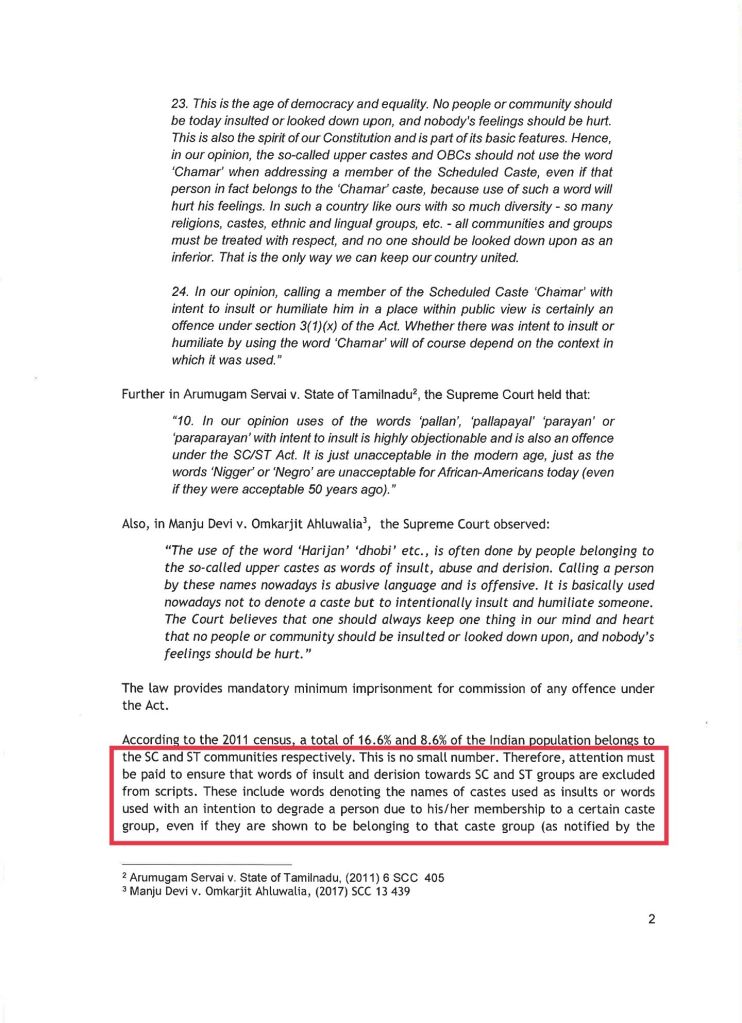
The advisory highlights pervasive issues such as the use of caste-based slurs, which perpetuate stereotypes and degrade “caste minorities.” It references several Supreme Court judgments to support its stance:
- Swaran Singh v. State: This judgment discusses the derogatory use of the term “chamar” as a caste-based slur, emphasizing its offensive nature and injurious impact on dignity.
- Arumugam Servai v. State of Tamil Nadu: The judgment identifies terms like “pallan” and “parayan” as abusive and draws parallels with historically offensive terms such as “Negro” in the United States.
- Manju Devi v. Omkarjit Ahluwalia: This judgment highlights terms like “Harijan” and “Dhobi,” noting their evolution into caste-based slurs.
These legal precedents underline the damaging impact of caste-based language and the importance of avoiding it in televised content.
The Advisory’s Recommendations
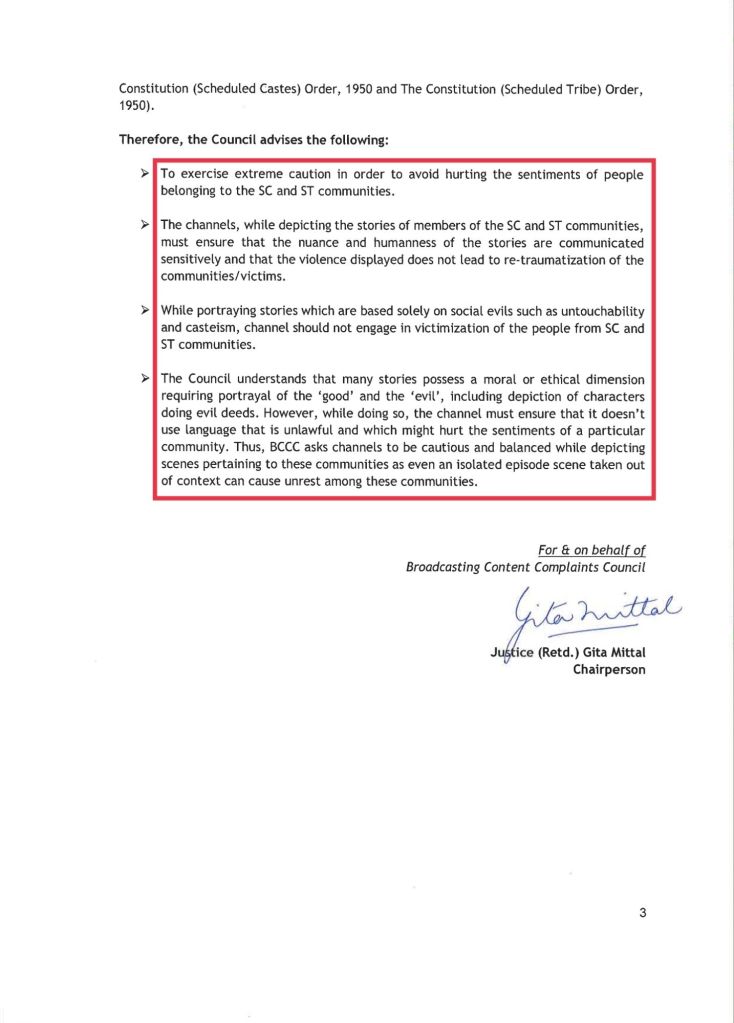
The BCCC’s advisory provides four key directives:
1. Exercise caution to avoid offending SC and ST communities.
2. Portray their stories sensitively, avoiding re-traumatization.
3. Refrain from victimizing these communities in depictions of casteism.
4. Avoid unlawful language that could hurt their sentiments.
While these guidelines aim to protect marginalized communities, they raise concerns about stifling authentic representations of caste-based oppression.
Implications of the Advisory
The advisory’s emphasis on excluding caste-based slurs, such as “chamar,” risks diluting the authentic representation of casteism. Such language, though offensive, is a harsh reality for many SC and ST individuals. Depicting this reality is essential for exposing the systemic violence and discrimination faced by these communities.
Instead of fostering protection, the advisory’s directives could result in a chilling effect on artistic expression. Content creators may shy away from depicting the brutal realities of casteism, thereby undermining the goal of fostering societal awareness and change.
Artistic freedom is a cornerstone of democracy and social progress. The advisory’s focus on sanitizing content under the guise of protection risks censorship. Television has a unique ability to evoke empathy and provoke thought through honest portrayals. By restricting the depiction of caste-based abuse, the advisory limits television’s potential to catalyze social change.
The advisory’s recommendations seem to prioritize protecting upper-caste sensitivities over exposing their complicity in caste-based violence. Depicting an upper-caste individual using a slur like “chamar” is not an endorsement of casteism but an indictment of its pervasive presence in society. Suppressing such portrayals inadvertently shields upper-caste groups from accountability.
Real & Honest Depictions of Casteism
Accurate depictions of casteism are crucial for acknowledging and addressing its systemic roots. Sanitizing these portrayals risks erasing the lived experiences of SC and ST communities. For instance, showing upper-caste individuals using caste-based slurs and engaging in discriminatory practices provides a stark reminder of the prejudices that persist in Indian society.
While sensitivity is essential, it should not come at the cost of authenticity. Content creators must navigate this balance by ensuring that their intent is to critique and expose casteism rather than perpetuate it. This approach can help amplify marginalized voices and challenge oppressive structures.
Representation of SC and ST Communities
The advisory highlights a glaring issue: the lack of SC and ST representation in self-regulatory bodies like the BCCC. Decisions affecting marginalized communities should involve their voices and perspectives. Without representation, policies risk being disconnected from the realities of those they aim to protect.
Analogous to the importance of women’s representation in gender-related policymaking, SC and ST representation is vital in shaping policies addressing casteism. Including members of these communities in regulatory bodies ensures that their lived experiences inform content guidelines and advisories.
Recommendations
1. Encourage Authentic Storytelling: Content creators should focus on portraying casteism authentically, ensuring that their narratives challenge stereotypes and inspire societal change.
2. Promote Inclusive Representation: Regulatory bodies like the BCCC must include SC and ST representatives to ensure that their voices shape policies.
3. Foster Public Awareness: Instead of censoring content, efforts should focus on educating audiences about the realities of caste-based discrimination.
4. Support Artistic Freedom: Creators should be given the freedom to depict casteism’s harsh realities, provided their intent is to critique and expose these injustices.
Therefore, the BCCC’s advisory on the portrayal of SC and ST communities reflects a well-intentioned but flawed approach to addressing casteism on television. While the goal of protecting marginalized communities is laudable, the advisory risks suppressing authentic portrayals of caste-based oppression and limiting artistic freedom. To truly address casteism, regulatory bodies must prioritize authentic storytelling, inclusive representation, and societal accountability. Only then can television serve as a powerful medium for exposing and dismantling caste-based discrimination.
References
1. Broadcasting Content Complaint Council’s (BCCC) Advisory on Portrayal of SC and ST Communities on Television, Indian Broadcasting & Digital Foundation: https://www.ibdf.com/advisories
2. Swaran Singh v. State of Punjab (Supreme Court of India, 2008).
3. Arumugam Servai v. State of Tamil Nadu (Supreme Court of India, 2011).
4. Manju Devi v. Omkarjit Ahluwalia (Supreme Court of India, 2014).

Leave a comment