
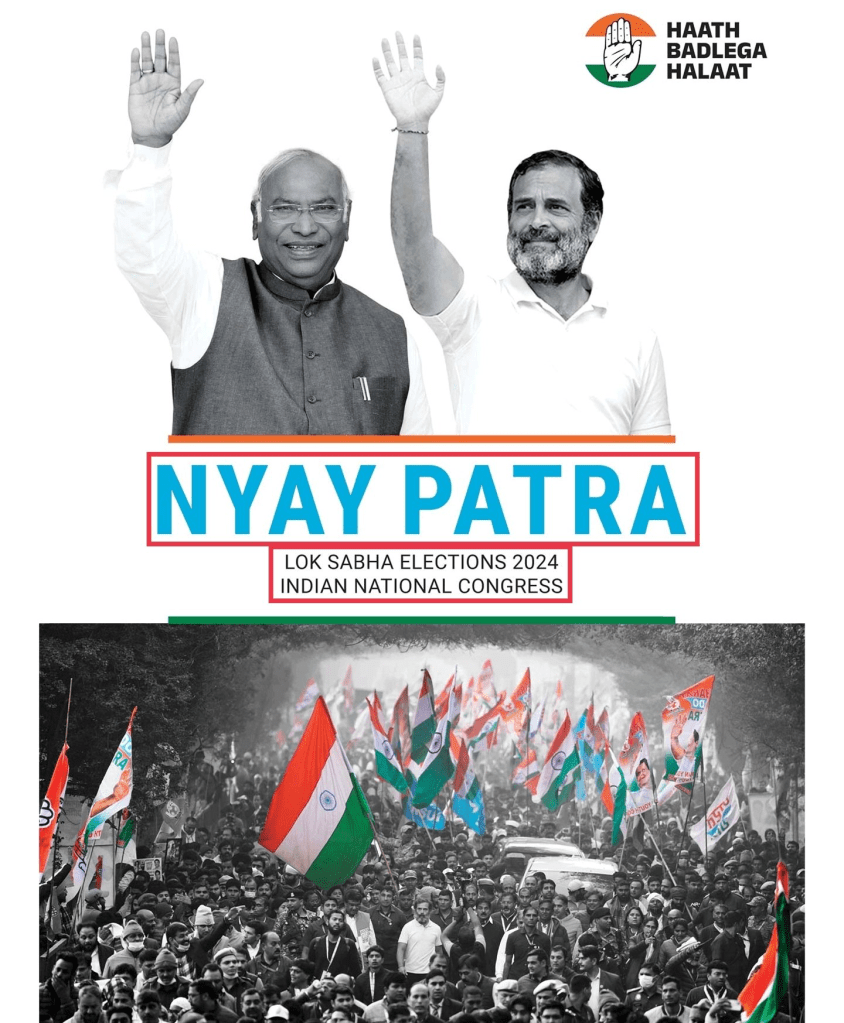
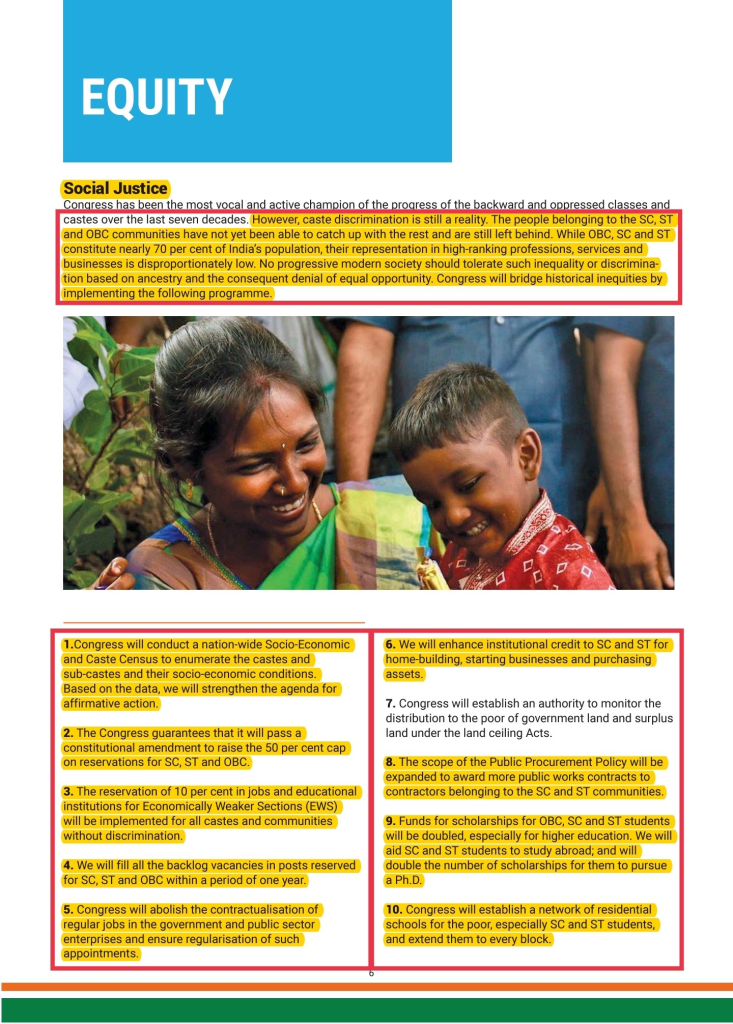
The Indian National Congress’ election manifesto, Nyay Patra, acknowledges the reality of caste and caste-based discrimination. It recognizes the disproportionately low representation of Scheduled Castes and emphasizes the need to address historical inequities. However, it does not propose a legislative pathway for the annihilation of caste. The manifesto omits critical issues related to the Scheduled Castes and the Scheduled Tribes (Prevention of Atrocities) Act, 1989. It employs vague and open-ended language, lacking specificity, and fails to provide justifications for contentious issues.
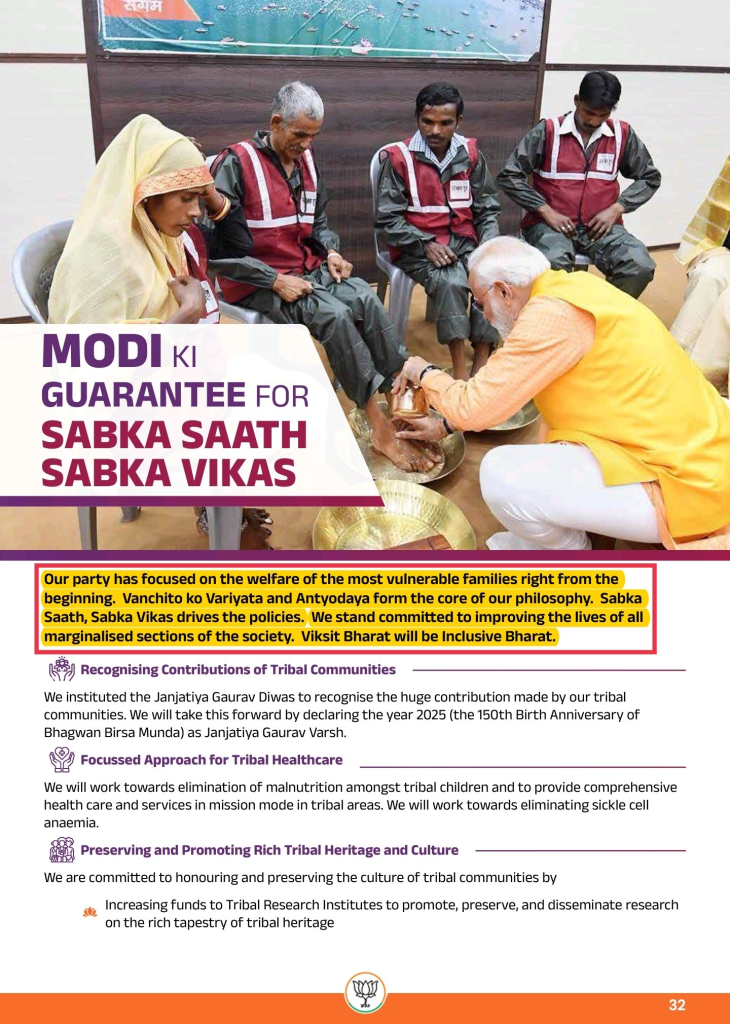
The Bharatiya Janata Party’s election manifesto, Sankalp Patra, guarantees improvements in the lives of all marginalized sections of society. It also promises that a Viksit Bharat (Developed India) will be an Inclusive Bharat (Inclusive India). However, it does not commit to a legislative pathway for the annihilation of caste. The manifesto makes no mention of caste or caste-based discrimination. It also omits references to the Scheduled Castes and the Scheduled Tribes (Prevention of Atrocities) Act, 1989, and does not address the issue of proportional representation.
Promises in INC’s Nyay Patra

1. Diligent Enforcement of the Scheduled Castes and the Scheduled Tribes (Prevention of Atrocities) Act, 1989
NyayPatra promises that the Act will be enforced diligently. It says a helpline will be established in every state. It also promises to provide legal aid and paralegal support to the victims of caste-based atrocities. However, the SC/ST community has already been waiting for the “diligent” enforcement of the Act since 1989. What we need is a complete overhaul of the Act. The manifesto should have promised about closing all the legal loopholes in the Act.
2. Strict Implementation of the Manual Scavenging Act, 2013
NyayPatra promises to end manual scavenging. It says there will be strict implementation of the Prohibition of Manual Scavenging Act, 2013. However, there has been no mention of ending the biggest loophole in the Act, i.e., the artificial distinction between manual scavenging and hazardous cleaning. It also does not promise to ensure 100% mechanization.
3. Caste Census
NyayPatra promises to conduct a nation-wide socio-economic and caste census. It points out that it will enumerate both the castes and the sub-castes. This promise will prove to be highly beneficial for the Scheduled Castes community. It will provide the necessary quantifiable data which will then become the basis for ensuring proportional representation for all the marginalized communities.
4. Raising 50% Cap on Reservation
NyayPatra promises a constitutional amendment to raise the existing 50% cap on caste-based reservations. This will ensure proportional representation of the marginalized communities, and will help implement the true constitutional meaning of equality.
5. Castes in 10% EWS Reservation
NyayPatra promises that both the SC/ST and the OBC community will be included in the 10% reservation currently mandated for the Economically Weaker Section (EWS). It will be expanded to include all castes and communities. This step will ensure equitable representation of the EWSs of all communities irrespective of their caste status. However, the income criterion for determining the EWS status should be lowered.
6. Filling Backlog Vacancies
NyayPatra promises to fill all backlog vacancies in posts reserved for the Scheduled Castes, the Scheduled Tribes, and the Other Backward Classes. However, the promise of only filling backlog vacancies is not enough. The manifesto should have promised to target the deep-rooted institutional casteism which creates these backlogs in the first place.
7. Regularisation of Contractual Jobs
NyayPatra promises the abolition of contractualisation of regular jobs in the government services and the public sector jobs. It says that the party will ensure regularisation, instead of contractualisation. However, the manifesto conveniently ignored the recent phenomenon of lateral entries into the civil services. It does not promise to provide reservation in the lateral entry posts of the civil services.
8. Reservation in Private Sector
NyayPatra promises to enact a law to extend the policy of reservation in private educational institutions. It also promises to establish a “Diversity Commission” to ensure representation of all communities in private sector jobs. However, the manifesto should have given an explicit promise extending the reservation policy to the private sector jobs. Just having a statutory body for ensuring diversity in the private sector is not enough.
9. Institutional Credit to Scheduled Castes
NyayPatra promises to enhance the current limits on institutional credit to Scheduled Castes for home-building, starting businesses, and purchasing assets. This step will definitely ensure economic empowerment of the Scheduled Castes community. However, the manifesto should have also promised lower interest rates and zero collateral.
10. Public Procurement from Scheduled Castes
NyayPatra promises to expand the scope of the government’s public procurement policy by ensuring that more contracts are awarded to contractors belonging to the Scheduled Castes. This promise will definitely give a boost to entrepreneurship in the Scheduled Castes community. However, the promise to ensure easy access to low-interest loans should have also been made.
11. Scholarship for Scheduled Castes
NyayPatra promises that funds for the existing scholarships for Scheduled Caste students will be doubled. It also promises to provide aid to study abroad. However, it conveniently ignores the major follies in the existing National Overseas Scholarship (NOS) Scheme of the Ministry of Social Justice, Government of India. The NOS should be amended to provide separate scholarships for Masters and Ph.D. courses. The officer in charge of implementation of this scheme in the Ministry of Social Justice should belong to the Scheduled Castes community to check potential caste prejudice.
12. Residential Schools for Scheduled Castes
NyayPatra promises to establish a network of residential schools for the poor, especially the Scheduled Castes and the Scheduled Tribes students. It promises to extend them to every block. However, it does not talk about the safety of female students in these residential schools. It should have promised to ensure that there will be no compromise with the safety of female students in these schools.
13. Education on Social Justice
NyayPatra promises to include the life and work of social reformers in our school curriculum so as to spread the message of social justice. However, it should have also promised education on caste per se. Compulsory education on caste should not be swept under the carpet anymore.
14. Ambedkar Bhavan-cum-Library
NyayPatra promises to establish “Ambedkar Bhavans/Libraries” in every district of the country so as to promote the habit of reading and discussion. However, it could have also promised that these bhavans will be utilised for running caste-sensitisation workshops. It should have mentioned that the reading of Annihilation of Caste (1936) will be promoted in these libraries.
15. Scheduled Caste Sub-plan
NyayPatra promises to pass a law authorising allocation of resources for the Scheduled Castes Sub-plan within the annual budget. It also promises to monitor the execution of the plans. However, it should have also promised that the monitoring of the sub-plan will be under the exclusive control of ministers and officers belonging to the Scheduled Castes community to check caste prejudice.
16. Rohith Vemula Act
NyayPatra promises to enact the Rohith Vemula Act to address caste-based discrimination faced by students in educational institutions. This promise of a separate specialised statute is good. However, it should have also promised criminalisation of caste-based hounding and harassment of reserved category students.
17. Diversity Commission
NyayPatra promises to establish a Diversity Commission to measure, monitor and promote diversity in public and private employment and education. However, just measuring, monitoring, and promoting diversity is not enough. Diversity can only be ensured through statutory enactments.
Promises in BJP’s Sankalp Patra

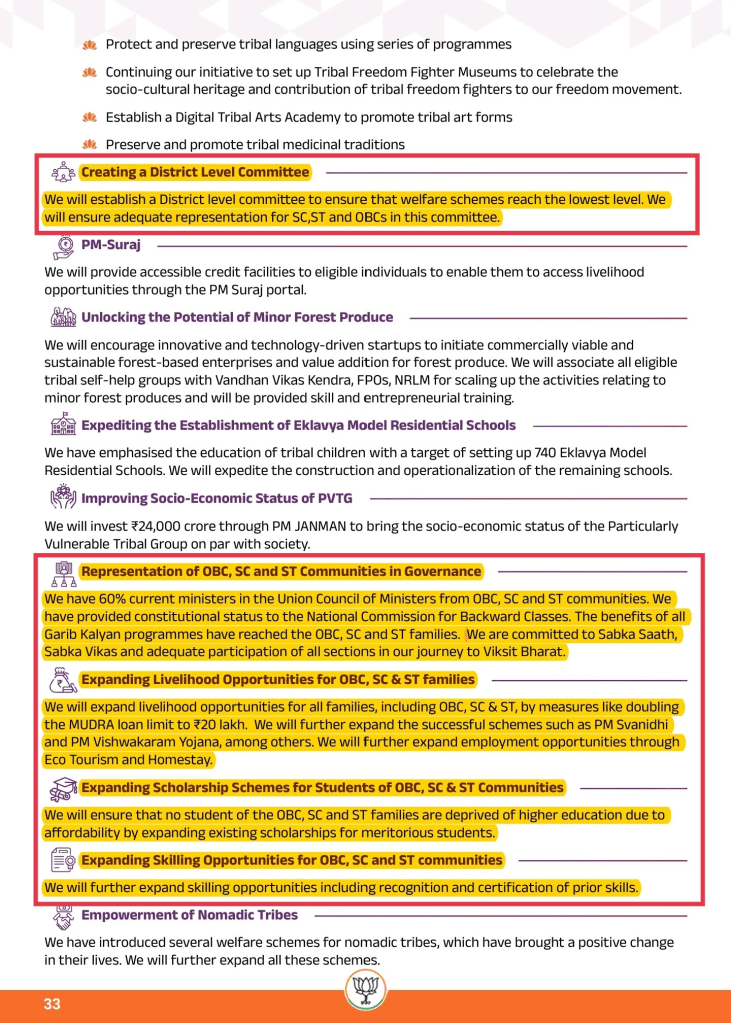

1. Establishing District Level Committees
SankalpPatra promises to establish District Level Committees to ensure that welfare schemes reach the lowest level. It also promises to ensure adequate representation of the Scheduled Castes in these committees. It is a novel initiative. However, for these committees to be effective, it is necessary to make the District Administration accountable to them.
2. Adequate Representation of Scheduled Castes in Governance
SankalpPatra mentions that 60% ministers in the Union Council belong to the Scheduled Castes, Scheduled Tribes, and Other Backward Classes. It promises to ensure adequate participation of all sections. However, it is important for the BJP to understand that the Scheduled Castes do not need “adequate” but “proportionate” representation, and the only way to ensure that is conducting a nationwide Caste Census.
3. Expanding Livelihood Opportunities for Scheduled Caste Families
SankalpPatra promises to expand the livelihood opportunities for the Scheduled Castes, the Scheduled Tribes, and the Other Backward Classes. It also promises to double the MUDRA loan limit to ₹20 lakh. This promise will definitely ensure economic empowerment of the Scheduled Castes community. However, it is necessary to ensure low interest rates and zero collateral.
4. Scholarship Scheme for Scheduled Castes
SankalpPatra promises to ensure that no student of the Scheduled Castes, the Scheduled Tribes, and the Other Backward Classes will be deprived of higher education. It also promises to expand the existing scholarships. However, it does not mention anything about shortcomings in the National Overseas Scholarship (NOS) scheme. It should have promised to ensure that the officer in charge of the scholarship in the Ministry of Social Justice belongs to the Scheduled Castes.
5. Skilling Opportunities
SankalpPatra promises to expand the existing skilling opportunities. It also promises to ensure recognition and certification of prior skills. However, there is nothing specific guaranteed for the Scheduled Castes community in particular. It also does not acknowledge the special circumstances of the community.
6. Empowerment of Safai Karamcharis
SankalpPatra mentions the existing Namaste Yojana. It promises to ensure safety, respect, and livelihood for the Safai Karamcharis. It also promises to continue to expand these initiatives. However, it does not mention anything about the abolition of the artificial distinction between manual scavenging and hazardous cleaning.
References
1. Indian National Congress’ NyayPatra: https://manifesto.inc.in/
2. Bhartiya Janata Party’s SankalpPatra: https://www.bjp.org/bjp-manifesto-2024

Leave a comment