

The chief architect of the Constitution of India, Dr. B. R. Ambedkar, had a singular purpose: the annihilation of caste. He set this act of annihilation in motion by enshrining special protective provisions in the Constitution. These provisions were designed to shield the lowest castes in the caste hierarchy, who were most affected by the caste system, from the onslaught of caste-based discrimination.
The lowest castes were grouped together and classified as the “Scheduled Castes” in the Constitution. The basis for this classification was the shared nature of discrimination they faced at the hands of the so-called upper castes. This classification, rooted in the common thread of discrimination uniting these castes, became the constitutional identity of the Scheduled Castes community.
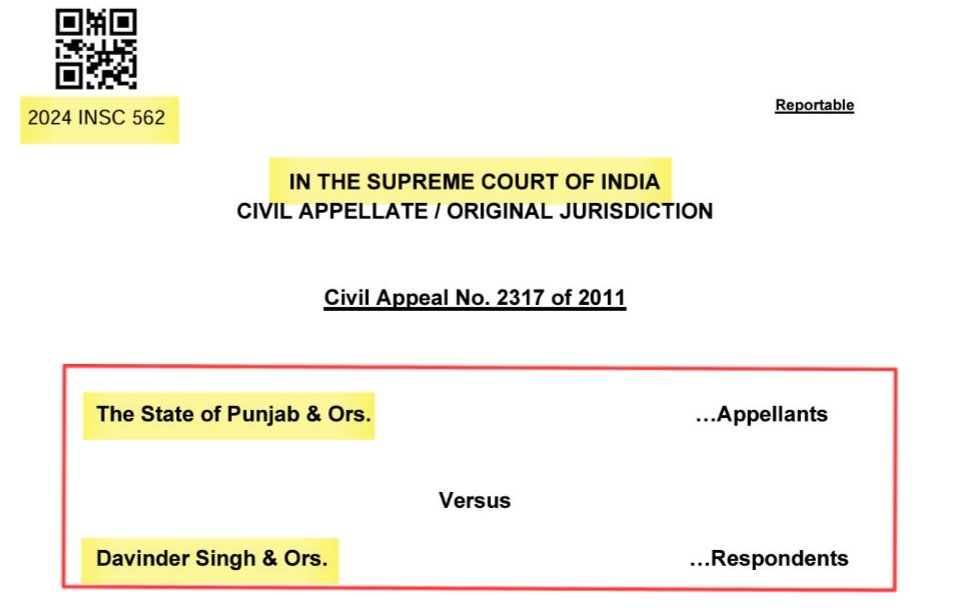
However, rather than working toward annihilating the scourge of caste and caste-based discrimination, the Supreme Court of India, in State of Punjab v. Davinder Singh (2024 INSC 562), deemed it appropriate to annihilate the constitutional identity of the Scheduled Castes community itself. The Court targeted the constitutional classification of the lowest castes as the Scheduled Castes and has now empowered state governments to sub-classify the community. The black robes are once again barking up the wrong tree!

Issues Involved in the Case
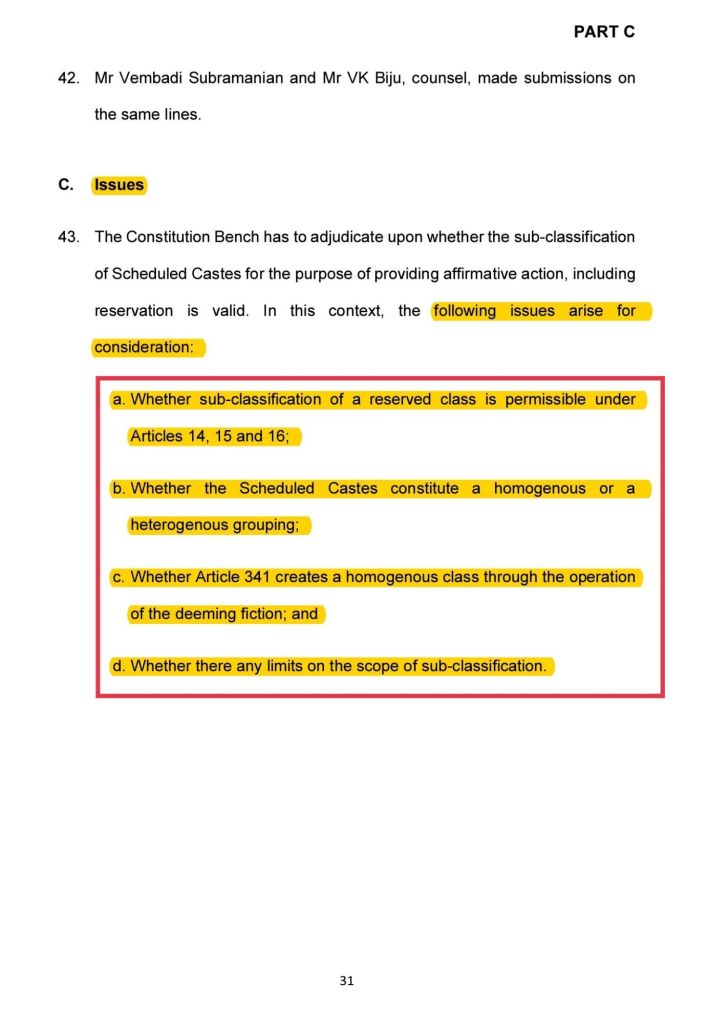
The following four issues were considered by the Supreme Court of India in this case:
| No. | Issues |
|---|---|
| Issue 1 | Whether the sub-classification of a reserved class is permissible under Articles 14, 15, and 16. |
| Issue 2 | Whether the Scheduled Castes constitute a homogeneous or heterogeneous grouping. |
| Issue 3 | Whether Article 341 creates a homogeneous class through the operation of the deeming fiction. |
| Issue 4 | Whether there are any limits on the scope of sub-classification. |
The Constitutional Identity of Scheduled Castes
The Constitution of India is often described as a living document, evolving with time and societal needs. The Scheduled Castes—initially a legal fiction to categorize historically disadvantaged communities—have since developed into a sociological reality. Their constitutional identity is intrinsically linked to contemporary caste-based discrimination and socio-economic vulnerabilities. The term “Scheduled Castes” no longer merely signifies a list of communities but embodies a collective experience of oppression and systemic marginalization.
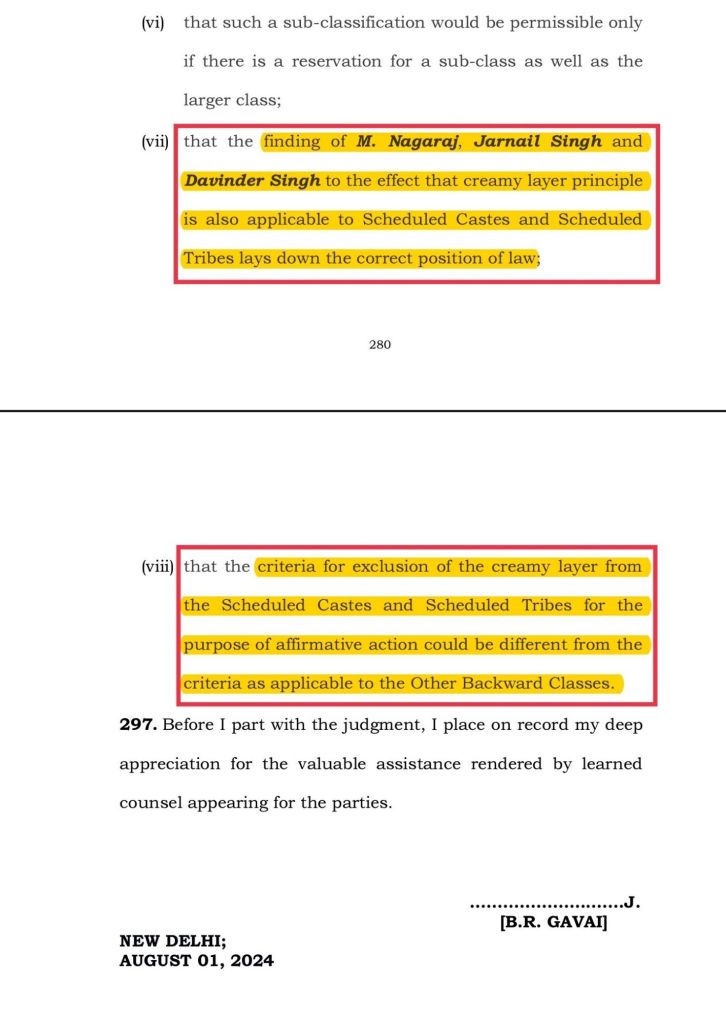
The judgement raises questions about whether the judiciary understands this nuanced identity. By endorsing sub-classification and suggesting a “creamy layer” within the Scheduled Castes, the Court risks fracturing the collective identity of these communities. Such a move undermines the unity essential for addressing systemic inequalities rooted in caste.
Homogeneity Rooted in Discrimination
The homogeneity of Scheduled Castes lies in the pervasive discrimination they continue to face. Across India, casteist practices persist in various forms—from social exclusion to economic exploitation. Alarmingly, the term “Scheduled Caste” itself has acquired pejorative connotations, often used as a slur akin to terms like “Chamar” or “Bhangi.”
This shared experience of stigma and violence forms the basis of the Scheduled Castes’ constitutional identity. Fragmenting this group through sub-classification risks diluting the focus on addressing systemic caste discrimination. Instead of recognizing their shared struggles, such measures pit one sub-group against another, diverting attention from the larger goal of annihilating caste.
Judiciary’s Incompetence in Socio-legal Analysis
The judiciary plays a pivotal role in interpreting the Constitution and addressing social issues. However, in cases involving caste, the Court often appears disconnected from ground realities. The socio-legal context is as critical as the legal framework, yet many judges and amici curiae lack an understanding of the lived experiences of marginalized communities. This disconnect is partly attributed to the collegium system, which perpetuates elitism within the judiciary.
The judgement reflects this incompetence. By addressing issues like the creamy layer—which were not even argued before the Court—the judiciary has overstepped its mandate. Such judicial overreach undermines the credibility of the institution and raises questions about its ability to uphold social justice.
J. Gavai’s Endorsement of Creamy Layer
Justice Gavai’s endorsement of the creamy layer concept within the Scheduled Castes has sparked controversy. The creamy layer—a principle originally applied to Other Backward Classes (OBCs) to exclude the economically advanced—has no constitutional basis within SC/ST reservations. Its application to the Scheduled Castes undermines the historical rationale for caste-based reservations, which is rooted in social and educational backwardness rather than economic criteria.
Moreover, J. Gavai’s remarks on the creamy layer were mere obiter dicta, having no binding legal effect. Critics argue that this reflects poor judicial propriety, as the issue was not part of the case’s arguments. Furthermore, J. Gavai’s approach has been criticized for being overly “Sanskritized,” suggesting a disconnect from the realities of caste oppression in 2024. His stance is seen by some as an attempt to gain social validation from upper castes, rather than representing the interests of the Scheduled Castes.
J. Trivedi’s Intricate Dissent
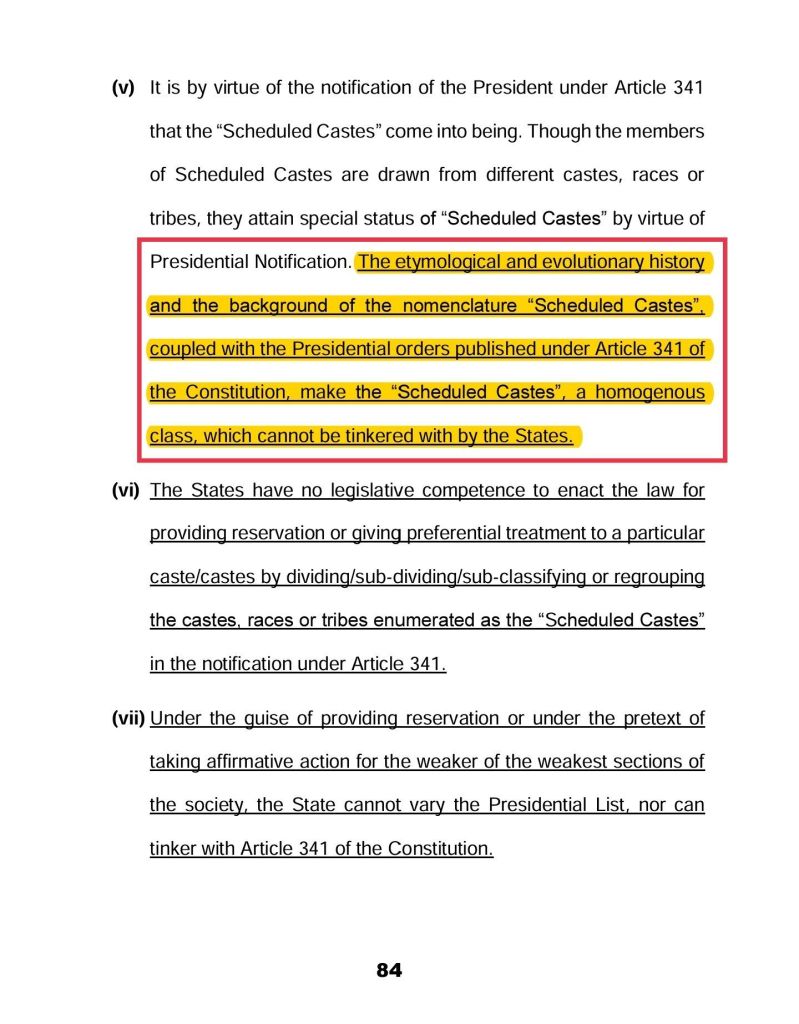
In contrast, Justice Trivedi’s dissenting opinion provides a more nuanced understanding of the Scheduled Castes’ constitutional identity. Her analysis delves into the etymology and history of the term “Scheduled Castes,” emphasizing the importance of collective identity in addressing caste-based discrimination.
Justice Trivedi’s dissent challenges the notion that only members of a marginalized community can adjudicate issues affecting that community. Her intricate reasoning underscores the importance of an empathetic and informed judiciary, capable of understanding the broader socio-legal implications of its decisions.
Fighting for the Reservation Pie
The narrative that some Scheduled Castes are “no longer backward” has gained traction, often propagated by upper-caste groups seeking to dilute the reservation system. This has led to the theory of inter-se backwardness, fostering rivalry among the Scheduled Caste sub-groups for limited reservation benefits.
Such internal divisions play into the hands of those opposed to reservations, weakening the collective struggle for social justice. The judiciary’s endorsement of sub-classification exacerbates these divisions, shifting focus from the need to expand opportunities for all the Scheduled Castes to an internal contest over the existing “pie.”
Sub-classification Before Annihilation
The sub-classification of Scheduled Castes and the introduction of a creamy layer are premature measures that undermine the original intent of caste-based reservations. These policies should only be considered in the context of a broader legislative framework aimed at annihilating caste itself. Without such a framework, these measures risk perpetuating caste hierarchies rather than dismantling them.
The Scheduled Castes must prioritize the goal of caste annihilation over short-term adjustments to reservation policies. Unfortunately, the community’s leadership appears increasingly content with the status quo, losing sight of the larger objective of achieving a caste-free society.
Therefore, the Supreme Court’s judgement in State of Punjab v. Davinder Singh marks a significant moment in India’s ongoing struggle with caste. While the judiciary’s role is to uphold the Constitution, its actions in this case have been criticized for eroding the constitutional identity of the Scheduled Castes. The endorsement of sub-classification and the creamy layer within the Scheduled Castes threatens to fragment the community and weaken the fight against systemic discrimination.
To honor Dr. Ambedkar’s vision, India must focus on annihilating caste rather than perpetuating it through judicial overreach and divisive policies. The path forward requires a judiciary that is empathetic, informed, and committed to the principles of social justice.
References
1. State of Punjab v. Davinder Singh (2024 INSC 562).
2. Annihilation of Caste (1936), B.R. Ambedkar.

Leave a comment