
Manufacturing Reasonable Doubt
Caste Prejudice in Special SC/ST Courts
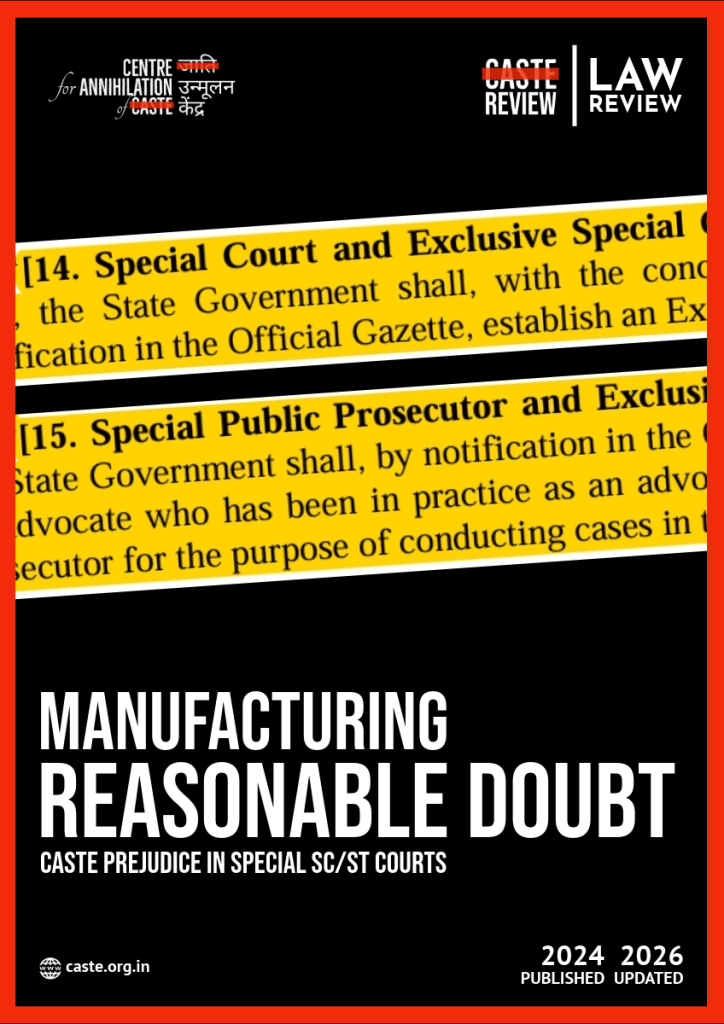
About: The report analyzes the phenomenon of manufacturing reasonable doubt by the cohort consisting of the Investigating Officer, Special Public Prosecutor, and Judge of the Special SC/ST Court under the Scheduled Castes and the Scheduled Tribes (Prevention of Atrocities) Act, 1989.
Publisher: Caste Review, Centre for Annihilation of Caste
Author: Gaurav Singhal
First Published: 10 March 2024
Updated Edition: June 2026
Publication Code: CR-RR-2024-04
Suggested Citation: Centre for Annihilation of Caste, Manufacturing Reasonable Doubt: Caste Prejudice in Special SC/ST Courts, CR-RR-2024-04 (Caste Review 2024; updated June 2026).
Abstract: The low conviction rate in cases under the Scheduled Castes and the Scheduled Tribes (Prevention of Atrocities) Act, 1989, cannot be attributed solely to the alleged filing of false cases, as is often claimed. In reality, several systemic issues contribute to this phenomenon, including legal loopholes, procedural delays, and flawed investigations. Among the most concerning reasons is the deliberate subversion of justice through what has been termed the “Manufacturing of Reasonable Doubt.” It is an insidious practice prevalent in many Special SC/ST Courts, where key functionaries, driven by caste prejudice, intentionally create circumstances that push the complainant-victim to turn hostile. This tactic compels the complainant-victim to withdraw their statement, fail to identify the accused, or deny critical particulars of their earlier testimony. Given that a conviction requires proof beyond reasonable doubt, the deliberate manufacturing of such doubt results in acquittals.
Stakeholders Targeted: National Commission for Scheduled Castes (NCSC); Ministry of Social Justice and Empowerment (MoSJ&E); Scheduled Castes (SC) Morcha, Bharatiya Janata Party (BJP); Scheduled Castes (SC) Department, Indian National Congress (INC); Scheduled Castes (SC) Departments of Major National and State Political Parties; and Elected Members of the Parliament of India and State Legislative Assemblies from Constituencies Reserved for Scheduled Castes.
⚠️ WARNING: We continuously monitor the use of our work after publication, and any unauthorised use without proper attribution, citation, or acknowledgement will be acted upon. We reserve the right to take appropriate action against any person, publication, or platform responsible for such unauthorised use of our work.