
Problem of Public View
Loophole in Sections 3(1)(r) & 3(1)(s) of the Prevention of Atrocities Act
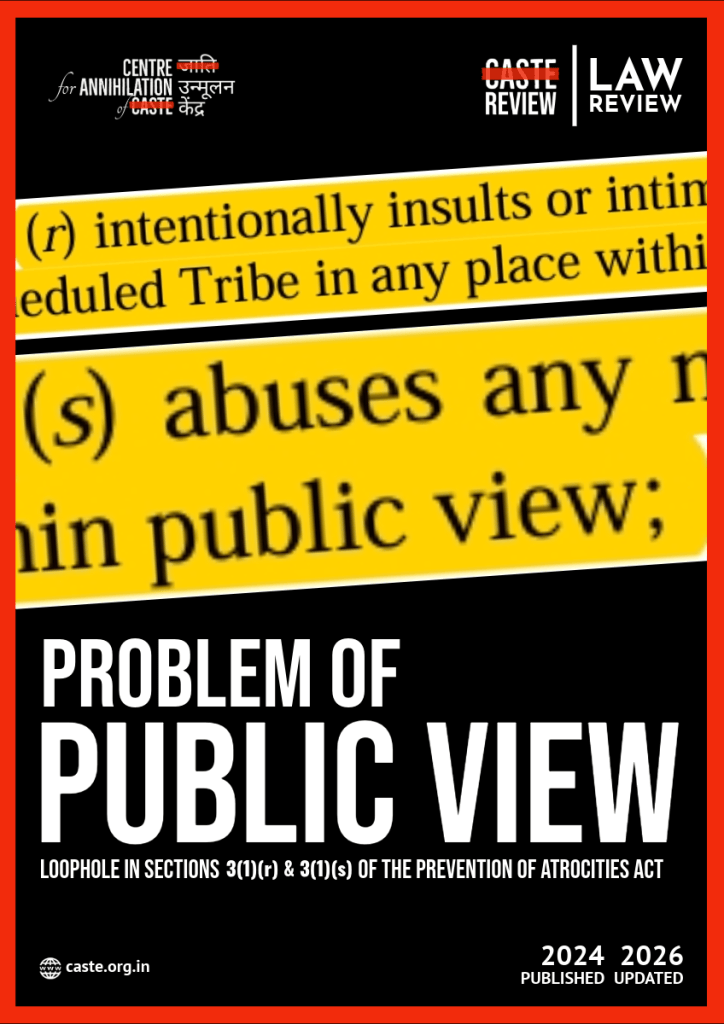
About: The report analyzes the legal loophole of “public view” in Sections 3(1)(r) & 3(1)(s) of the Scheduled Castes and the Scheduled Tribes (Prevention of Atrocities) Act, 1989.
Publisher: Caste Review, Centre for Annihilation of Caste
Author: Gaurav Singhal
First Published: 18 February 2024
Updated Edition: June 2026
Publication Code: CR-RR-2024-03
Suggested Citation: Centre for Annihilation of Caste, Problem of Public View: Loophole in Sections 3(1)(r) & 3(1)(s) of the Prevention of Atrocities Act, CR-RR-2024-03 (Caste Review 2024; updated June 2026).
Abstract: There are three scenarios in which a person can hurl caste-based insults or abuse using the “C-word” and still evade liability under Sections 3(1)(r) and 3(1)(s) of the Scheduled Castes and the Scheduled Tribes (Prevention of Atrocities) Act, 1989: (1) when the insult or abuse occurs in a private place, not within public view; (2) when the insult or abuse occurs in a private place, not within public view, but in the presence of the complainant’s relatives or friends; and (3) when the insult or abuse occurs during a private conversation conducted over a phone call or through electronic messages. In all these scenarios, evidence such as audio or video recordings, even if provided by the complainant, does not affect the outcome.
Stakeholders Targeted: National Commission for Scheduled Castes (NCSC); Ministry of Social Justice and Empowerment (MoSJ&E); Scheduled Castes (SC) Morcha, Bharatiya Janata Party (BJP); Scheduled Castes (SC) Department, Indian National Congress (INC); Scheduled Castes (SC) Departments of Major National and State Political Parties; and Elected Members of the Parliament of India and State Legislative Assemblies from Constituencies Reserved for Scheduled Castes.
⚠️ WARNING: We continuously monitor the use of our work after publication, and any unauthorised use without proper attribution, citation, or acknowledgement will be acted upon. We reserve the right to take appropriate action against any person, publication, or platform responsible for such unauthorised use of our work.